ULTRASONIC TESTING (UT) – SKM Level 2 Direct Access (MC-113-2)
A Single Week Course, A Full Pass
Request an inquiry
We’ll contact you shortly:
What We Will Cover
[block border=”5px solid #aacb24″ padding=”10px 15px”]
Course Durations : 6 Months (2 Months In-Classroom and 4 Months Practical In Industry)
|
Apply Now |
[/block]
ULTRASONIC TESTING (UT)
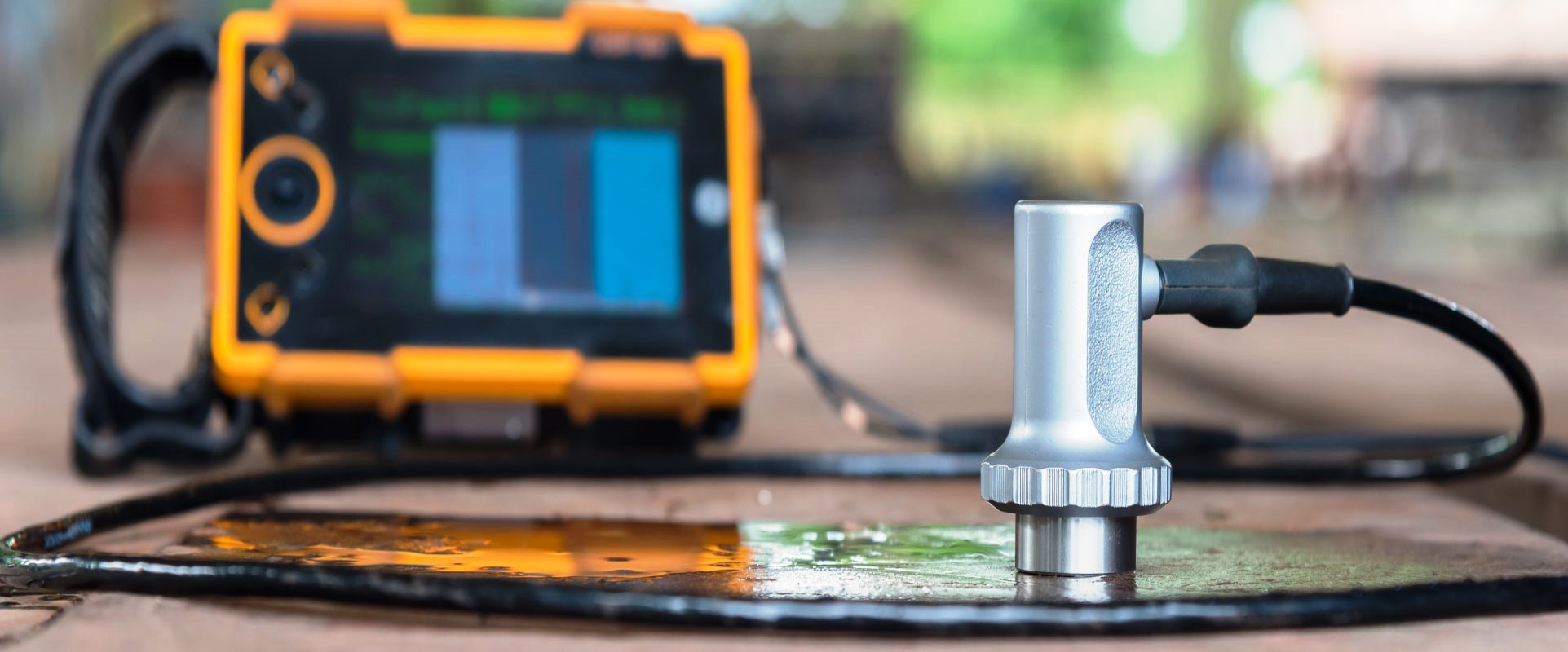
Ultrasonic Testing (UT) uses high frequency sound energy to conduct examinations and make measurements. Ultrasonic inspection can be used for flaw detection/evaluation, dimensional measurements, material characterization, and much more. Although there are a number of technologies employing ultrasound, the simplest explanation of what happens in this method is that sound energy is introduced via a transducer and propagates through the materials in the form of waves. When there is a discontinuity (such as a crack) in the wave path, part of the energy will be reflected back from the flaw surface. The reflected wave signal is transformed into an electrical signal by the transducer and is displayed or recorded in a variety of ways. Both surface and subsurface defects can be detected making ultrasonics a volumetric testing method. Applications vary in complexity from very small, hand-held manual units to very large, sophisticated automated systems. This method is used to inspect a variety of product forms including castings, forgings, and weldments. The structural steel, automotive, petrochemical, power generation, and aerospace industries are a few examples that utilize ultrasonic inspection.
Typical Applications
– Thickness Determination of Materials
– Inspection of Castings
– Inspection of Forgings
– Inspection of Welds
– Inspection of Aerospace Materials
Industries that use Ultrasonic
– Service Inspection Companies
– Smelters & Foundries
– Rolling & Forging Mills
– Petro Chemical & Refineries
– Mining & Mineral Processing
– Aircraft Maintenance & Manufacturing
– Vehicle Maintenance & Manufacturing
– Government Bodies
– Engineering Firms
– Research & Development Facilities
– Education & Training
– Equipment Manufacture & Sales
COURSE DESCRIPTION
A Course for those who already have basic understanding of the techniques of ultrasonic inspection and are wanting intensive instruction to improve their knowledge and increase their experience. The course is suitable for candidates who are wishing to progress towards any of the examination qualification. The course has a high practical content, all equipment is provided.
WHO SHOULD ATTEND
This course is opened to all participants, in particular NDT personnel, supervisors, NDT trainers, contractors and researchers and those who are interested in Ultrasonic Testing technique.
Prerequisite for this Class is Level I Ultrasonics
SCOPE
This course introduces the basic principles of Ultrasonics and prepares the candidate for straight beam inspections and thickness measurement.
This course prepares a candidate to
• Select equipment to conduct test
• Setup test equipment
• Steps to conduct test
• Calibration
• Familiarize with codes and standards
• Interpret results with respect to applicable codes and standards
• Understand limitation of the test method
• Write test reports.
TRAINING
Training material is presented in modules that are followed by quizzes
COURSE CONTENTS :
MODULE 1: MANUFACTURING DISCONTINUITIES
• Types of Discontinuities: Inherent, Processing and Service
• Casting Discontinuities: Hot Tear, Cold Shut, Porosity, Shrinkage
• Primary Processing Discontinuities including discontinuities in Rolling, Forging, Drawing, Extruding
• Secondary Processing Discontinuities including discontinuities in Grinding, Heat Treating, Machining, Welding, Plating
• Service Discontinuities:- Erosion, Wear, Fatigue, Corrosion, Creep
MODULE 2: WAVE MODES
• Time Period and Frequency
• Wavelength
• Wave Modes including Longitudinal, Shear, Surface and Lamb Waves
• Velocity of Waves
• Calculation of Velocity
• Factors Affecting Velocity – Temperature, Stress
MODULE 3: ACOUSTIC IMPEDANCE
• Acoustic Impedance
• Calculation of Acoustic Impedance
• Reflection and Transmission Coefficients
• Transmission through a layer
MODULE 4: REFRACTION AND REFLECTION
• Reflection and Refraction
• Snell’s Law
• Mode Conversion
• First and Second Critical Angle
• Problems on Mode Conversion
MODULE 5: PIEZOELECTRIC TRANSDUCER
• Wave Interference: Constructive and Destructive
• Sound Field
• Near Field
• Far Field
• Beam Spread
• Problems on Near Field and Beam Spread
• Principles of Piezoelectricity
• Curie Temperature
• Transducer damping
• Bandwidth
• Type of Transducers
• Contact and Immersion Transducers
• Dual Element, Delay Line, Angle Beam Transducer
• Couplant
MODULE 6: PULSER RECEIVER
• Ultrasonic Instrumentation – Analog
• Ultrasonic Instrumentation – Digital
• Time Base
• Pulse Repetition Rate
• Types of Ultrasonic Display – A, B and C Scan
• Calibration of Ultrasonic Equipment
MODULE 7: ATTENUATION
• Sound Attenuation
• Causes for Attenuation
• Attenuation Measurement
• Calculation of Amplification
• Laboratory – Measurement of Attenuation
MODULE 8: THICKNESS MEASUREMENT
• Test Modes
• Thickness Measurement
• Thickness Measurement Frequency
• Screen Calibration
• Problems
• Laboratory – Thickness measurement, Lamination Check
MODULE 9: IMMERSION TESTING
• Advantages and Limitations of Immersion Testing Technique
• Types of Immersion Testing Transducers
• Bubbler/Squirter Technique
• Wheel Type Transducer
MODULE 10: FLAW DETECTION – 0 DEGREE
• Lamination, Thickness Measurement
• ASME Section V, Article 5
• ASTM standard SA-578 Straight Beam Examination
ULTRASONIC TESTING LEVEL 2 (UT2)
This course introduces the basic principles of ultrasonics and prepares the candidate for Angle Beam Inspections.
This course prepares a candidate to
• Select equipment to conduct test
• Set Equipment
• Steps to conduct test
• Calibration
• Familiarize with codes and standards
• Interpret results with respect to applicable codes and standards
• Understand limitation of the test method
• Write test reports.
MODULE 11: REFRACTION AND REFLECTION (Covered in Level I and II)
• Reflection and Refraction
• Snell’s Law
• Mode Conversion
• First and Second Critical Angle
• Creeping Waves
• Problems on Mode Conversion
MODULE 12: PULSER RECEIVER
• Calibration of Ultrasonic Equipment – Time and Amplitude Linearity
• All other Topics Covered in Level I Training
MODULE 13: CALIBRATION BLOCKS
• IIW Block Type I
• IIW Block Type II
• Miniature Angle Beam
• DSC Block
• AWS Resolution Block
• Step Wedge
• Area-Amplitude Block
• Distance-Amplitude Block
MODULE 14: ANGLE BEAM INSPECTION
• Selection of Screen Range
• Measurement of Beam Exit Point
• Measurement of Actual Refracted Angle
• Calibration using IIW, Rompass and DSC Block
• Sensitivity and Resolution
• Reference Amplitude
• Distance Amplitude Correction (DAC) Curve
• Time Corrected Gain (TCG)
• Discontinuity Length Sizing using 6 dB and 20 dB drop method
• Discontinuity Evaluation
• Selection of Screen Range
• Surface Distance, Skip Distance, Depth, Full V Path
• Plotting of Discontinuities like Crack, Lack of Fusion, Lack of Penetration, Slag, Porosity in welds
• Worksheet: Plotting of discontinuities for butt welds
MODULE 15: WRITING AN ULTRASONIC PROCEDURE
• ASME Section V
• Essential Variables
• Non Essential Variables
MODULE 16: CODES AND STANDARDS
• ASME Section V, Article 4 Weld Examination
• SA 388 Heavy Steel Forging
• AWS D1.1 (Option)
• Additional Codes Standards as per student’s requirements (please specify at the time of registration)
INTRODUCTION TO ADVANCED TECHNIQUES
• Time of Flight Diffraction
• Phased Arrays
PRACTICALS
Shear Wave Testing on Pipe Samples with embedded weld defects – ID Cracks, OD Cracks, Slag, Porosity, Lack of Fusion, Lack of Penetration
EXAMINATIONS
• General
• Specific
• Practical
• Candidates must score a minimum of 70% in each examination
General Information
Recommended Pre-Course Study
– Basic Mathematics – Trigonometry and Algebra


Call us for any inquiries about this course
- 03-8061 7275